
NEURAL FIRESTROME: UNLEASHING THE BOLTZMAN MACHINE
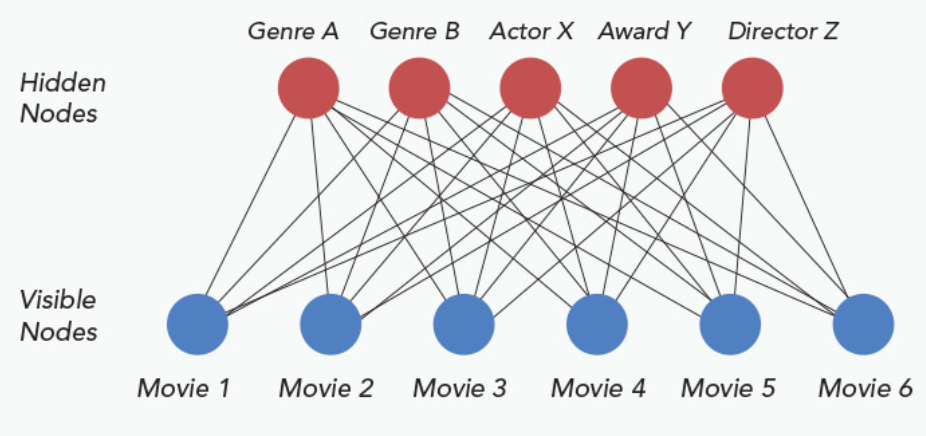
Think of your brain right after you step into a dimly lit room: billions of neurons fire, cross-talking simultaneously, trading signals across synapses until the fuzzy shapes around you collapse into a clear image. That spontaneous internal chatter is the foundation of a Boltzmann Machine.
Unlike typical feedforward AI that takes an input and pushes it straight to an output, a Boltzmann Machine behaves like a thinking brain at rest. It is a fully recurrent network of interconnected visible and hidden neurons that constantly "talk" to one another in both directions. It doesn’t just classify inputs; it imagines and reconstructs missing data on its own.
Driven by statistical physics, the network seeks dynamic balance by minimizing its total energy state:
P(v, h) = e^(-E(v, h)) / Z
Lower energy states represent coherent, stable memories, while high energy signals noise.Because fully connected networks explode computationally, modern systems use Restricted Boltzmann Machines (RBMs)—severing connections within the same layer to create a clean bipartite graph. Trained via Contrastive Divergence, RBMs power modern recommender systems by predicting user preferences and serve as the modular building blocks for Deep Belief Networks.
← Back to This Year's Articles